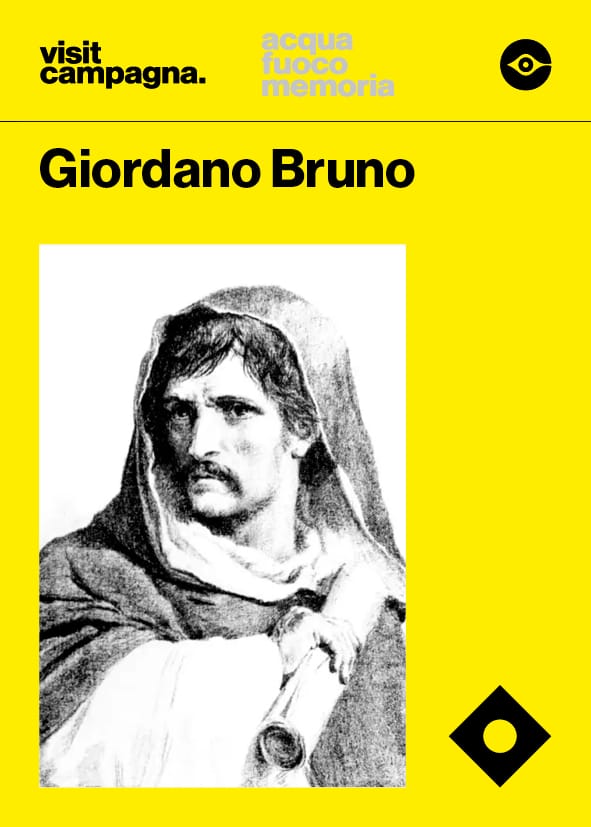


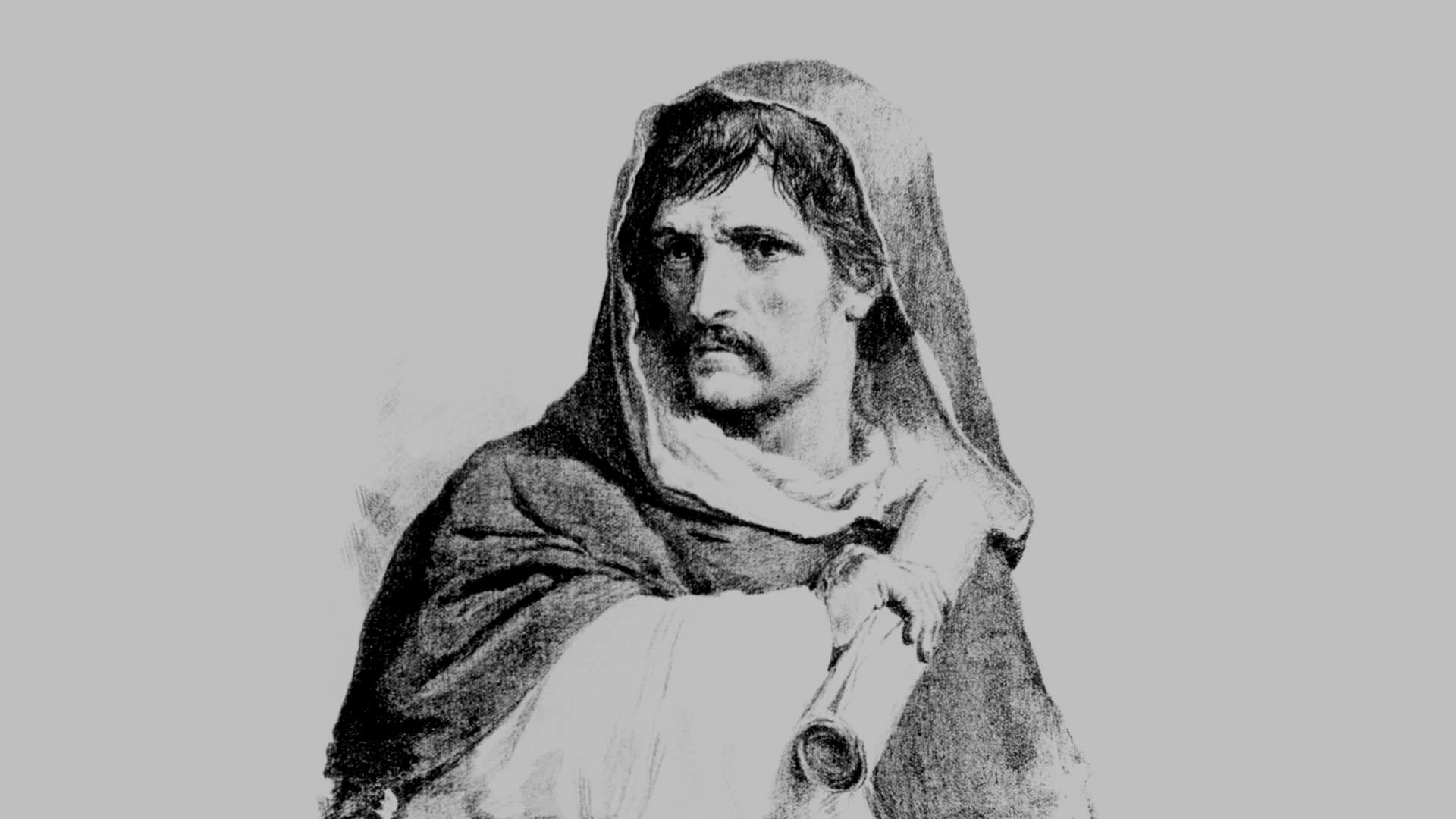
Giordano Bruno was born in Nola in 1548 under the name of Filippo Bruno. He joined the’Dominican Order in the convent of San Domenico Maggiore in Naples, He took the name Giordano and soon distinguished himself for his intellectual vivacity and breadth of interests: theology, philosophy, the art of memory, astronomy. His biography, reconstructed from the main historical sources and the acts of the Inquisition trial, shows him engaged in a long European pilgrimage between Italy, France, England and Germany, until his condemnation at the stake in Campo de’ Fiori in Rome on 17 February 1600.
Authoritative biographical sources mention that Bruno was ordained priest at 1573 and celebrated his first mass in the Dominican convent of San Bartolomeo in Campagna, near Salerno, then under the rule of the Grimaldi family, princes of Monaco. This episode, attested to in the studies dedicated to his education, directly links the philosopher from Nola to the city's religious history: Campagna thus enters, for a decisive moment in Bruno's life, into the human and spiritual landscape of the future philosopher.
Alongside this documented fact, some recent studies on Bruno's youth hypothesise that part of his Dominican initiation path may also have passed through Campagna, where he would have met one of his teachers in Naples. These are hypotheses put forward by specialised research, which enrich the picture but which historiography nevertheless maintains on a level of prudent verisimilitude. What remains certain, in any case, is the link between the first mass and the local memory that, over the centuries, has continued to recall Bruno's passage through the city.
In the main biographies of Giordano Bruno, from classical studies and encyclopaedic summaries, it is emphasised that his ordination to the priesthood took place in the 1573 and how the first mass was celebrated not in Naples, but in the Convent of St Bartholomew in Campagna. The convent, belonging to the Dominican Order, was at that time part of the seigniorial system of the Grimaldis, princes of Monaco, who held control over the Campagnese territory. It was in this context that Bruno, a young friar from Nola, entered the priestly ministry for the first time.
Specialised studies on the youth of Bruno, based on archive documents, also recall that, once he had begun his studies in Naples, the friar was able to go to Campagna for his initiation with peace of mind, finding as prior of the convent of San Bartolomeo one of the masters of San Domenico, Friar Eugenio Gagliardo of Naples. This reconstruction, proposed by more recent historiography, confirms the existence of close relations between the Neapolitan Dominican world and the religious community of Campagna in the second half of the 16th century.
The connection between Giordano Bruno and Campagna does not end with the erudite memory of his first mass. During the 20th century, the city chose to enhance this memory by dedicating associations, cultural initiatives and museum spaces to the philosopher. In 1988, the ’Associazione Giordano Bruno“ was founded, based in Campagna, which promotes cultural exchanges, conferences and moments of reflection on Bruno's thought and the themes of freedom of conscience and the dignity of the person.
In the historical centre, inside the former Dominican convent, is the Museo Campagna - G. Bruno Art Centre, run in cooperation with the Giordano Bruno Association. The museum exhibits ethno-anthropological materials related to the farming civilisation and hosts artistic and cultural initiatives, incorporating Bruno's name in a path that combines historical memory, contemporary art and territorial identity. On the occasion of the fourth centenary of the stake (2000), a special postal cancellation and a commemorative postcard were also created, testifying to the importance of the figure of the philosopher from Nola for the Campagnese community.
Through these symbolic and cultural choices, Campagna recognises himself in a part of Giordano Bruno's story: not so much in the doctrinal controversies, but in the value of research, inner freedom and intellectual courage, which still speak today to those who visit its places and delve into its history.