
La Church of St. Anthony stands along the provincial road SP 234, in the heart of the Quadrivio di Campagna, the most modern and populous hamlet of the municipality. It belongs to the parish of Santa Maria La Nova e was born as a subsidiary church, designed to offer a liturgical and community reference point for those who live and work in this flat area, marked by daily traffic and rapid building expansion.
This is a recently constructed building, an expression of the’contemporary religious architecturea small church with a rectangular ground plan, simple and regular in form, which does not focus on monumentality but on functionality and proximity to everyday life. Precisely for this reason, in the landscape of the Quadrivio, Sant'Antonio has become over time a discreet but recognisable sign of Christian presence along the provincial road.
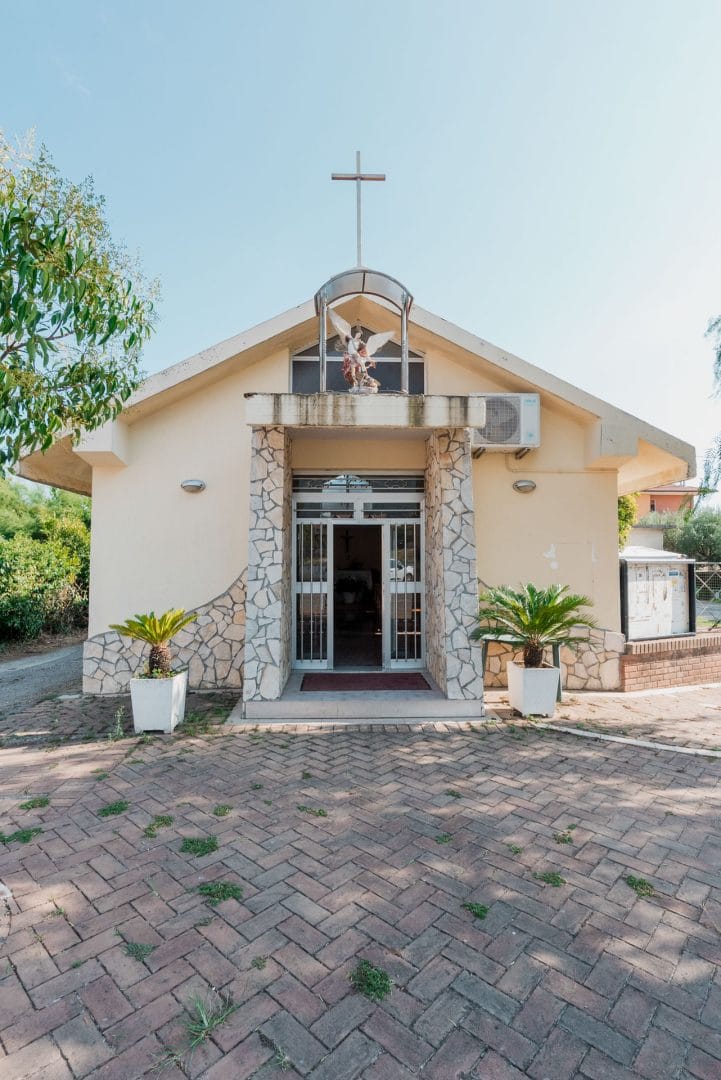
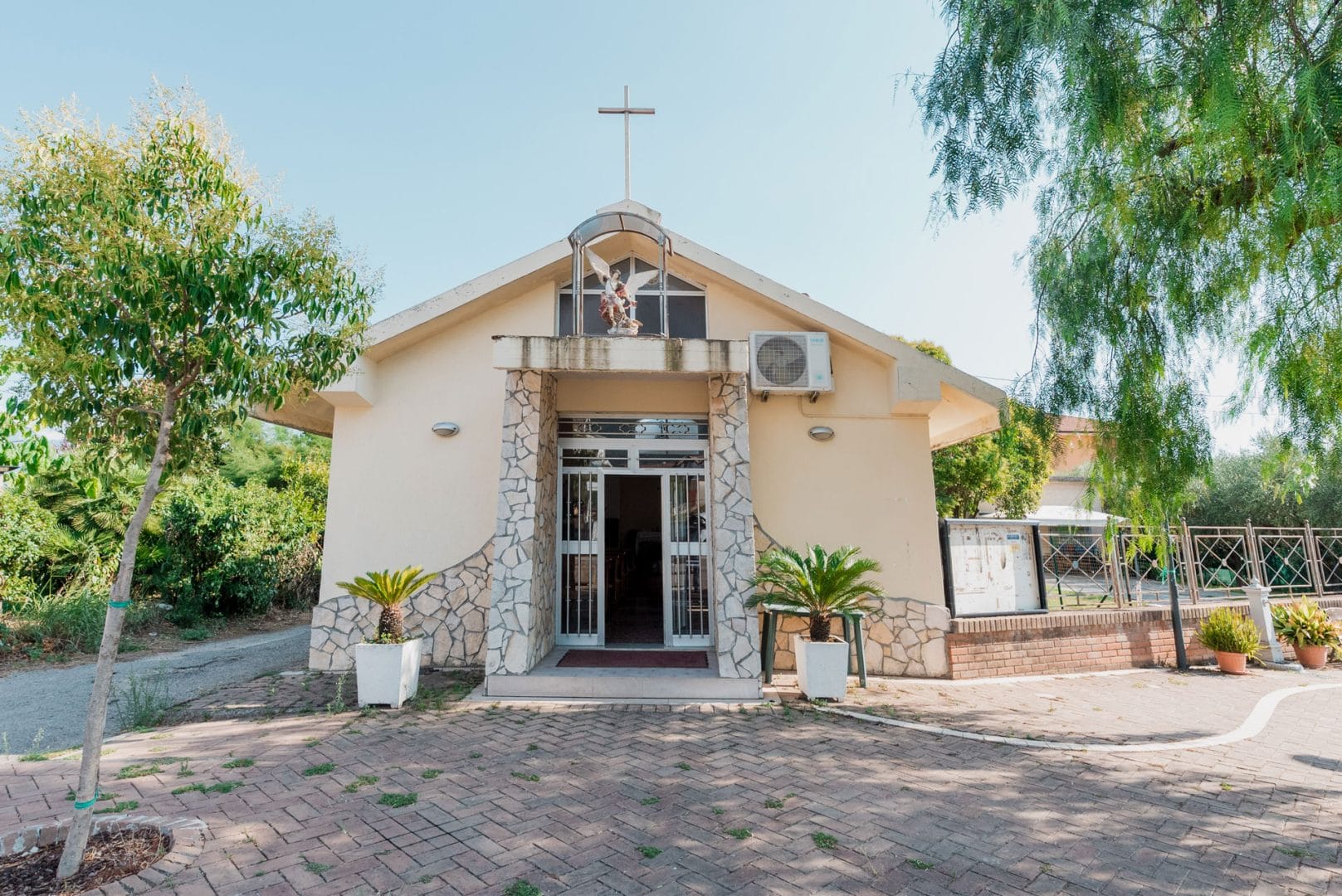
The main façade is characterised by a cadvanced body clad in opus incertum stone, which frames the aluminium entrance door. Above the small access porch protrudes a covering shelf, on which the statue of St Michael Archangel, protected by a metal structure, with a glass window behind it that fits between the two pitches of the roof. This vertical element, visible even from a distance, constitutes the true “sign” of the church in the fabric of the Quadrivio.
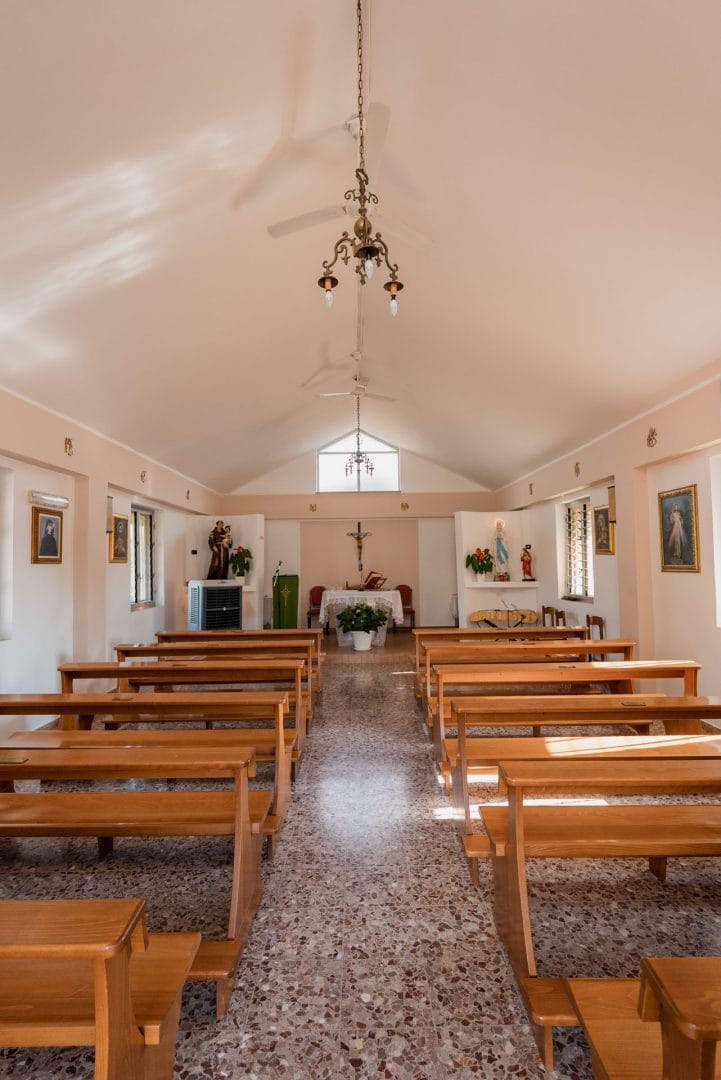
Inside, the liturgical hall is single, with the presbytery slightly raised at the back. Natural light enters through rectangular windows on the side elevations and two large windows: one on the façade, above the entrance, and the other on the back wall of the presbytery. The whole creates a simple but luminous environment, suitable for weekday and Sunday celebrations and moments of personal prayer for the faithful of the hamlet.
According to the official records of the BeWeB census and the portal “The Churches of the Italian Dioceses”, the church of St. Anthony is characterised by a’modern architecture, recently built, set in the context of the newly constructed Quadrivio di Campagna. It is not a historical building in the strict sense of the word: no precise foundation dates or articulated construction phases are known, and the historical information given is deliberately essential.
This structural “normality”, however, tells much about the role the church plays: more than a monument, St. Anthony is a presence of proximity, a place where liturgical life is grafted into the rhythms of the fraction. Its location along the provincial road SP 234 makes it easy for those moving between the centre of Campagna, the surrounding countryside and the nearby municipalities of the Sele Plain.
The building meets the typical criteria for sacred buildings of the second half of the twentieth century: reinforced concrete structure, latero-concrete floors, two-pitch roof with brick tile covering, grit marble flooring in the nave and porcelain stoneware flooring in the presbytery area. The language is sober, devoid of excessive ornamentation, but cared for in the key points: façade, entrance, altar area.
It is precisely this sobriety that makes St Anthony's a church “close” to the lifestyle of the Quadrivio: a comprehensible building, easy to live in, that privileges spaces for assembly and listening rather than theatrical effect. A place where the community recognises itself in simplicity rather than monumental solemnity.
The most characteristic element of the Church of St. Anthony is the facade. The base and the advanced body of the portico are clad in opus incertum stone, which creates a material contrast with the plastered surfaces of the rest of the building. This stone cladding gives visual solidity to the entrance and, at the same time, dialogues with the surrounding rural landscape, where the stone has always been the material of choice for walls, low walls and terracing.
Above the small projecting portico runs a covering shelf that protects the entrance and supports the statue of St Michael Archangel, a figure particularly venerated in the Campania region. The archangel, depicted in the act of vanquishing evil, towers in the centre of the façade and becomes an immediate sign for those arriving from the provincial road, almost a visual “signboard” that ushers you inside.
Behind the statue, wedged between the two pitches of the roof, a stained glass window opens in axis with the portal. Together with the rectangular windows along the side elevations and the stained glass window at the back of the presbytery, it contributes to bringing diffuse and soft light into the hall. The pitched roof with brick tiles completes the profile of the church, giving it a familiar and easily recognisable appearance in the Quadrivio landscape.
Inside, the liturgical adaptation, carried out in line with the indications of the Second Vatican Council, led to the installation of a modern altar: a trapezoidal block of marble on which the protruding mensa rests, designed to encourage a more participatory celebration and greater closeness between the priest and the assembly. Here too, the choice favours sobriety and clarity over decorative effect.