
In historic centre of Campagna, in the oldest part of the village, stands Cozzi Palace, a building that holds a particularly significant history for the town. The sources of the City of Countryside ETS association recall how the palace, built in the early 13th century, originally began as a primordial city hospital, built on the site of an older chapel dedicated to St. Sophia. From its origins, therefore, this place is linked to the idea of care, welcome and assistance to the community.
Over the centuries the structure has been remodelled several times, up to the great rebuilding and restructuring phase of the 18th century, which gave it the appearance with which we know it today: a three-storey mansion, set on a compact layout and enhanced by an important entrance portal. The latter leads into an atrium paved with stone paving stones, which progressively introduces the interior spaces and the staircase body.
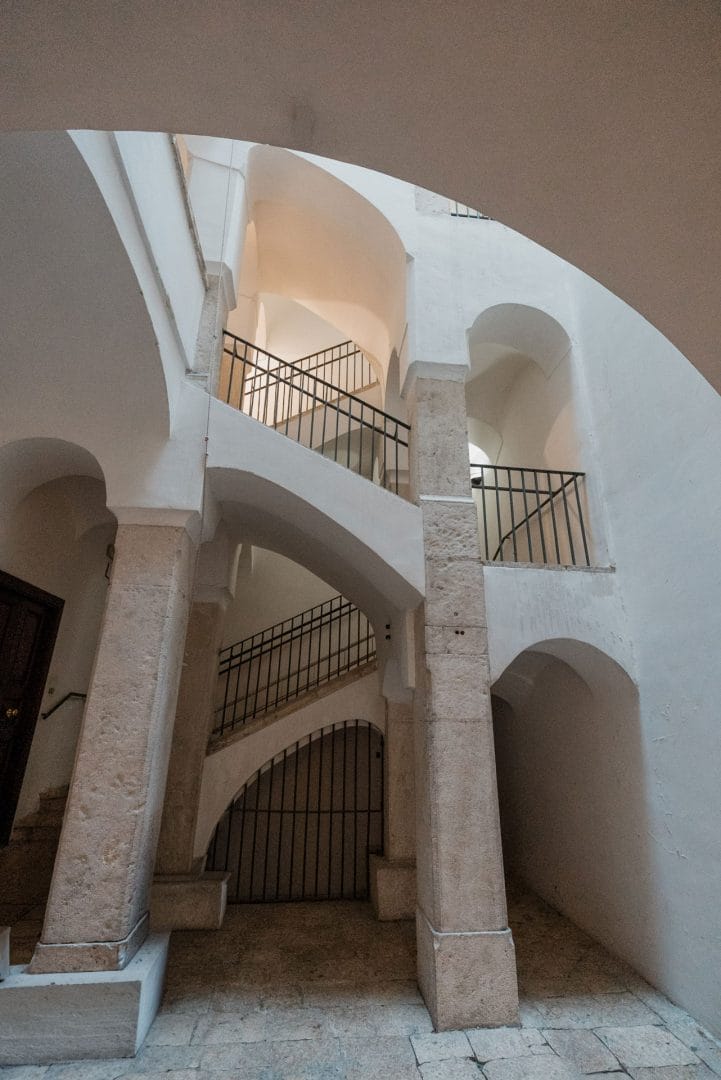
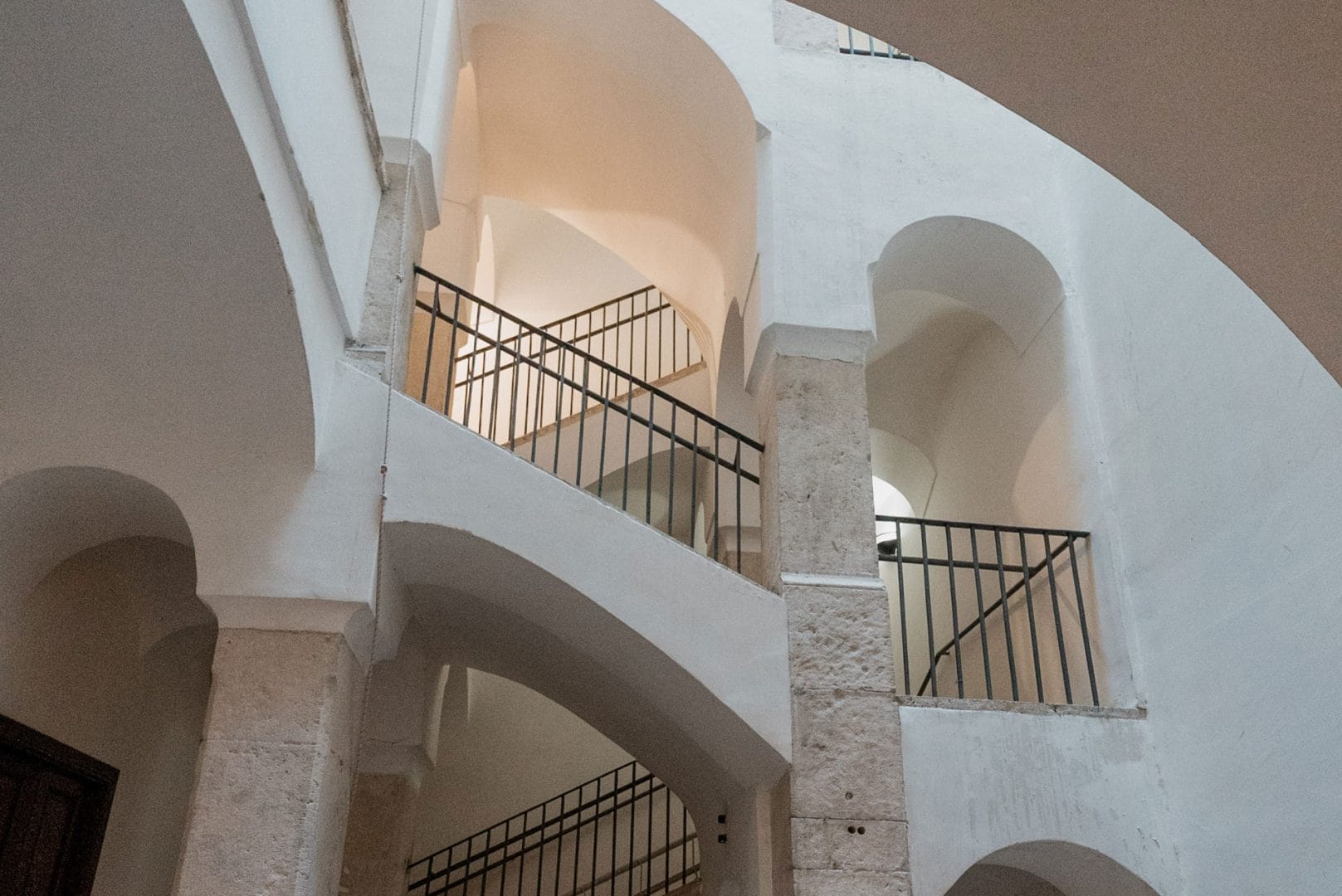
The staircase hall, composed of stone arches and pillars, is one of the most recognisable elements of the building: the alternation of solids and voids, of wall masses and openings, accompanies the gaze upwards and towards the upper floors, where the rooms for the residence and representative functions were once articulated. The robustness of the materials and the care taken in the construction give the image of a building capable of crossing the centuries, adapting to different uses without losing its character.
Today, Palazzo Cozzi is fully integrated into the country mansions and is part of the historic centre's enhancement paths, also through events that animate its main door and atrium. The transition from the original function of hospital to the dimension of historical residence open to cultural and gastronomic events testifies to the continuity of a role of service to the city, declined over time in different forms.
The information that Palazzo Cozzi was born as primordial city hospital, built in the early years of the 13th century to replace a chapel dedicated to St Sophia, places this building in a very special position compared to other noble palaces in Campagna. Before being a noble residence, the site was in fact a sacred and caring space, and was part of the network of places of worship and healing that characterised the centres of the mediaeval Mezzogiorno.
Medieval hospitals, often founded in continuity with chapels or small oratories, performed multiple functions: assistance to the sick and the poor, reception of pilgrims and wayfarers, support for the most fragile segments of the population. The decision to locate such a structure in the heart of the town, where Palazzo Cozzi was later to be built, reflects a conception of the city as a space in which the religious, civil and welfare dimensions were closely intertwined.
Over the centuries, economic, social and urban transformations led to the reorganisation of city spaces and the progressive ennobling of certain areas in the historic centre. In this process, the old hospital gave way to a larger residential building, which, however, retains, at least in historical memory, the trace of its original function. The mention of the chapel of St Sophia in local sources is a precious clue to this hidden continuity.
To read Palazzo Cozzi today in the light of this history is to recognise how behind the 18th-century portal and the three-storey architecture lies a place that, for centuries, has represented a concrete form of care for others: an intangible legacy that enriches the value of the palace far beyond its albeit relevant architectural aspects.
The 18th-century rebuilding and renovation of Palazzo Cozzi has bequeathed a coherent and refined architectural ensemble. The front is dominated by an imposing entrance portal, which concentrates in itself the representative function of the palace: to pass through it is to move from the rhythm of the street to the more intimate breath of the inner atrium.
L’atrium, paved with stone paving stones, gives the visitor back the immediacy of matter and time: the worn slabs tell of the passage of generations, while the walls and openings organise the space as a kind of decompression chamber between outside and inside. From here develops the refined structure leading to the three-storey building.
Particularly significant is the’stairwell, composed of stone arches and pillars: a solution that recalls models widespread in southern residential architecture between the 17th and 18th centuries, in which the vertical distribution of spaces is transformed into a true scenographic device. Climbing the stairs means passing through a succession of views, perspectives and cuts of light that enhance both the structure and those who pass through it.
In the current context, Palazzo Cozzi maintains this strong architectural identity, which makes it a significant stage in the routes dedicated to discovering the historic buildings of Campagna. On the occasion of initiatives such as “Gates, Skein & Sound”Its main door and atrium come alive once again, hosting tastings and encounters that renew the dialogue between the historic residence and the contemporary life of the city.