
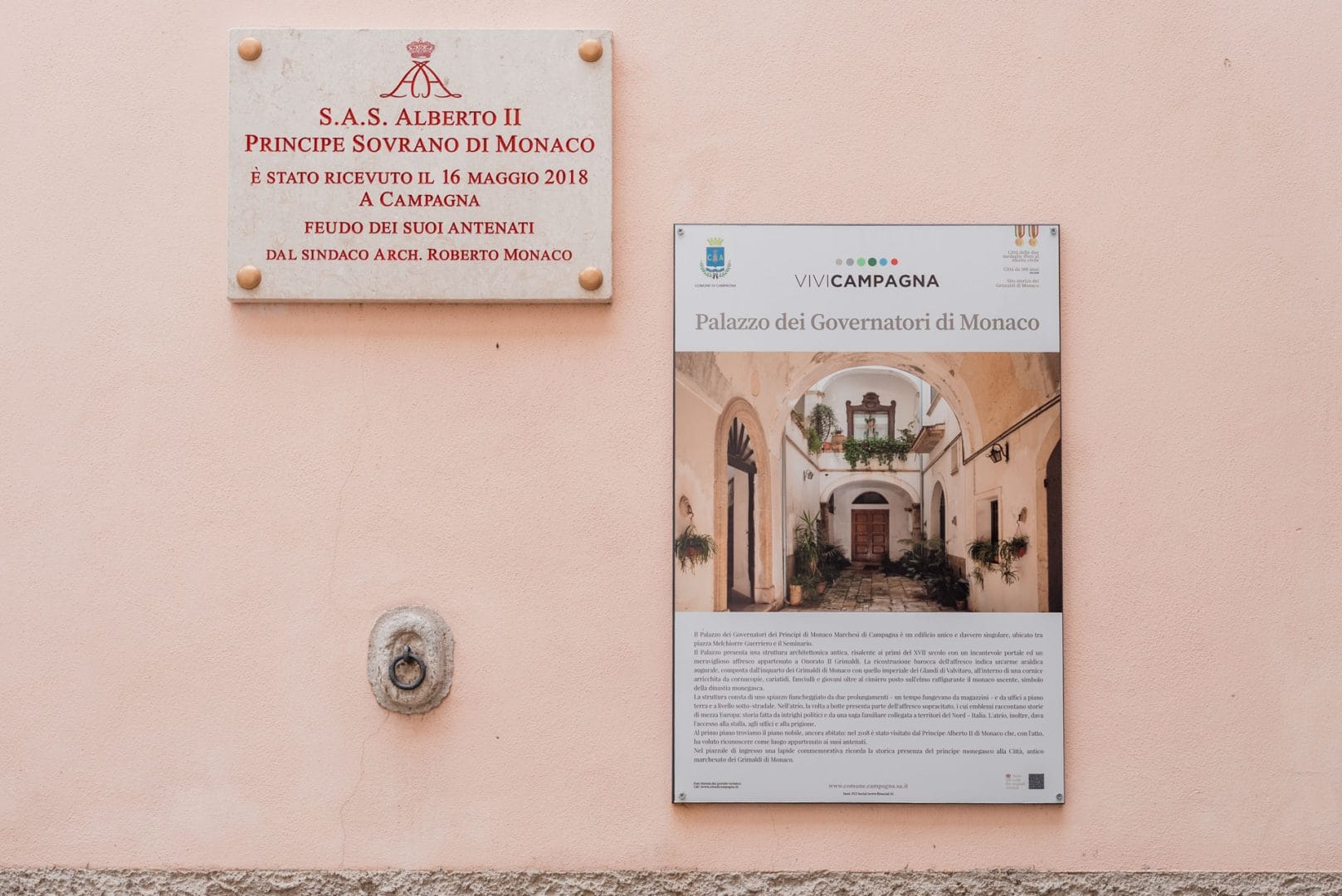
Behind Piazza Melchiorre Guerriero, in the heart of the historic centre of Campagna, overlooks the Palace of the Governors of the Princes of Monaco, one of the most recognisable testimonies to the period when the city was marquisate of the Grimaldi family. The building, dating from 16th century, stands slightly elevated above the square, along Via Seminario, where an imposing gateway in finely worked stone leads to a cosy and elegant interior atrium.
During the Marquisate of Campagna, when the Grimaldis of Monaco became the longest-serving feudal lords of the city, the palace housed the Governor appointed by the princesIt was here that feudal power was administered, relations with the local community were managed and the most important decisions for the territory were made. Its presence, close to the main square, was not accidental: the palace was a symbolic bridge between seigniorial authority and civil life, alongside other representative buildings such as the Town Hall and, a little further up, the Gerione Castle.
By baroque style, rooted in the late Renaissance architectural period, the Palazzo dei Governatori is distinguished by its carved stone portal, which still preserves the heraldic memory of its former lords. In the inner atrium, which is accessed from Via Seminario, one can still see the coat of arms of the Grimaldis of Monaco, alongside that of the Landi, princes of Val di Taro, allied and related to the Monegasque dynasty. The stone shield, scarred by time but still legible, recalls the period when Campagna was at the centre of a dense network of political relations that went beyond the borders of the Kingdom of Naples.
Today, the palace, which is included in tourist itineraries and guided tour programmes dedicated to the “secrets” of the Grimaldi family and the rediscovery of the marquisate of Campagna, is a fundamental stage in understanding how the city's history has been intertwined with that of the Principality of Monaco. The building is not only an architectural testimony: it is a tangible trace of the sometimes complex but fruitful dialogue between a small inland town in Campagna and one of Europe's most famous dynasties.
Froml 16th century Campagna experienced a period of particular prosperity: after the Orsini, the fiefdom passed to the Grimaldi of Monaco, who were awarded the title of Marquises of Campagna and maintained their rule there for a long time. In this context, the figure of the Governor, the direct representative of the principles, with extensive administrative and judicial powers.
The Governor's Palace was the place where this authority took concrete form: offices, reception rooms and service rooms formed the operational heart of feudal management. This was where citizens' petitions were received, minor justice was administered, tax flows were controlled and relations were organised with the other centres of the marquisate, which extended far beyond the boundaries of today's municipal territory.
Lo coat of arms carved in the atrium, combining the arms of the Grimaldis of Monaco with those of the Landis, princes of Val di Taro, recalls a dense web of matrimonial and political alliances, typical of the European nobility between the 16th and 17th centuries. Through these ties, Campagna entered a supra-local circuit that guaranteed it prestige, investment and a prominent role in the dynamics of the Kingdom of Naples: this was the period in which churches were renovated, palaces were built, academies and cultural initiatives were promoted, leaving a legacy that is still visible in the urban fabric.
Visiting the palace today, it is possible to read this story of diffuse power in the watermark: not a fortified castle, but an urban residence that tells of a different form of government, closer to modern administrative logic than to the purely military logic of the Middle Ages.
L’identity of the Governor's Palace is mainly played out in the relationship between inside and outside. Towards the city, the façade looking towards Piazza Melchiorre Guerriero appears relatively sober, in line with much of Campagna's civil architecture: regular openings, restrained cornices, a compact volumetry that dialogues with the other historic buildings in the centre.
It is through Via Seminario, however, that the building reveals its most representative characterHere the finely worked stone portal leads into a vaulted atrium, designed as a filter space between the public street and the government rooms. The decision to concentrate the decoration on the entrance and the interior reflects a typically Baroque taste, which favours the theatricality of the passage spaces and the effect of surprise once the threshold is crossed.
L’atrium, dominated by the noble coat of arms, acted as a veritable “visiting card” of feudal power: whoever entered, be it a representative of the local elite or a simple citizen summoned by the Governor, was immediately immersed in a language of symbols - crowns, shields, heraldic parties - that recalled Campagna's belonging to a wider network of domains and lineages.
Included today in the tourist routes promoted by the municipality and local associations, the palace dialogues with other nearby historical buildings - such as Palazzo Bernalla, Palazzo Viviani, the Palazzo Ducale and the Palazzo di Città - composing a unified itinerary to discover Campagnese civil architecture between the Renaissance and Baroque periods. Walking between Via Seminario and the square means, in just a few dozen metres, crossing centuries of history in which the city was able to transform the residences of power into shared heritage.