
In the ancient and imposing square dedicated to Julius Caesar Capaccio, in the district of Zappino, rises the Ducal Palace, residence of the last feudal lords of Campagna, the Pironti family. The building came into being at the end of the 17th century, when in 1694 the Ravellian patrician Nicola Pironti bought the Campagna fiefdom from the State, obtaining the title of first duke: to give visible form to his new power, he had a feudal palace built ex novo next to the Church of the Santissimo Salvatore.
To add lustre to the ducal residence, the Pironti even intervened on the churchThe bell tower is knocked down and the façade overturned, moving the main entrance to what is now Largo Giulio Cesare Capaccio. In this way, palace and church find themselves sharing the same urban scene, in a dialogue of façades that makes the centrality of the new feudal power in the heart of the city immediately perceptible.
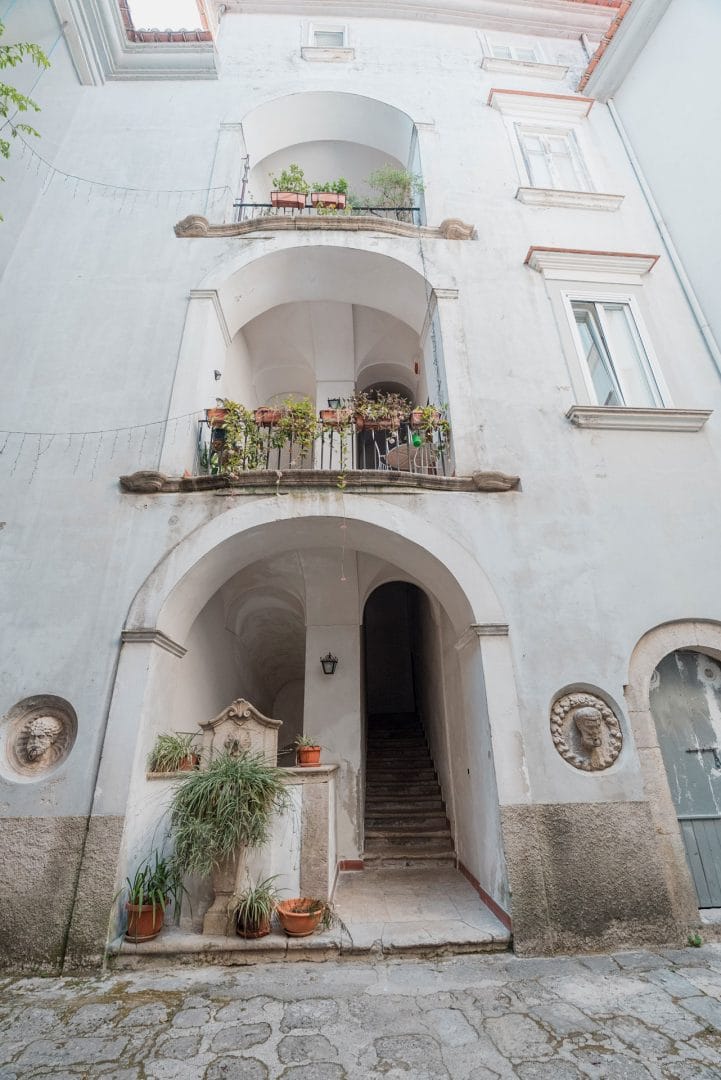
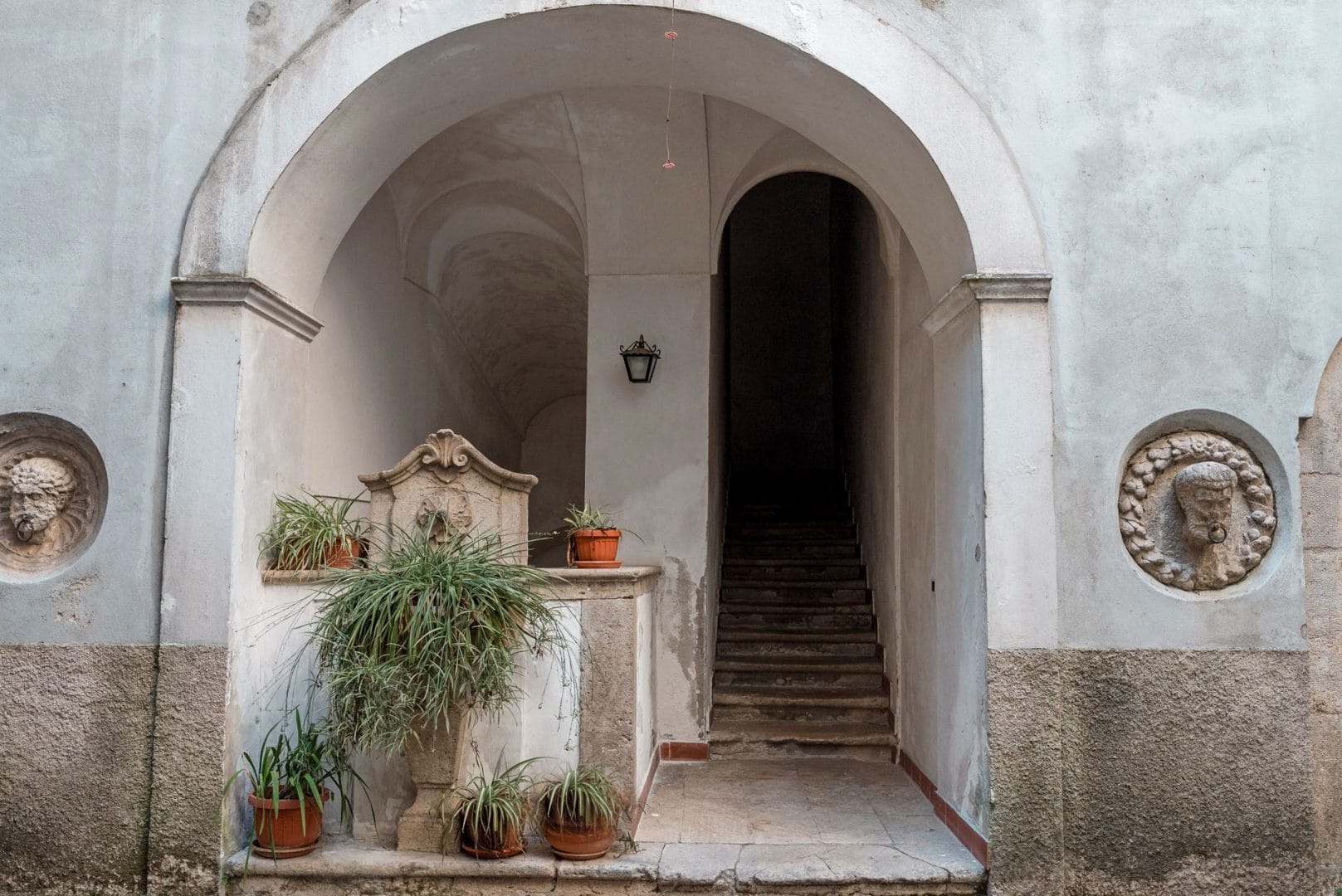
The Ducal Palace has a quadrangular floor plan, articulated on three levels arranged around a rectangular inner courtyard. The façade, plastered and painted in two shades of grey, is marked by a regular sequence of balconies and windows; on the ground floor are the fondachi and the large stone portal leading into the vaulted entrance hall, with a lunetted barrel vault and a fresco in the centre of the vault.
The vestibule leads to the courtyard, This is the scenographic heart of the palace: on three sides are galleries with large round arches, protected by wrought iron railings, which distribute the accesses to the various rooms. In the centre of the courtyard, a fountain with a stone mask and, on either side of the entrance to the staircase, two sculptural roundels depicting human heads recall the representative vocation of this space, designed to impress the visitor from the first glance.
The story of the Doge's Palace is inseparable from the Pironti family history. In 1694 the State sold the Campagna fiefdom to Nicola Pironti, a patrician of Ravello: with the purchase, he also obtained the title of first Duke of Campagna, following in the wake of those families of the Neapolitan patriciate who, between the 17th and 18th centuries, consolidated their rank through the acquisition of fiefs within the kingdom.
The decision to build a palace from scratch, rather than simply adapting an existing residence, is highly symbolic: the new duke intended to leave a strong mark on the city's urban fabric, redefining the balance between civil and religious spaces. It is no coincidence that the intervention also involves the Church of the Holy Saviour, with the demolition of the bell tower and the relocation of the façade to open it onto the same square as the palace.
During the 18th century, while Campagna went through a season of architectural renewal and other civil and religious buildings were built or completed, the Pironti palace took on the role of fulcrum of feudal powera seat of representation, a place of administration and, at the same time, a visible symbol of the new lordship. The main historical sources on the city, from De Nigris to Rivelli, refer to this phase as a key moment in the transformation of the town.
With the abolition of feudality, the Ducal Palace's political function disappeared, but the building continued to mark the profile of the square. Over time, the interior spaces were divided up and adapted to different uses; today, part of the complex houses an accommodation facility, while the courtyard and the portal remain highly recognisable elements for those walking through the historic centre of Campagna.
Architecturally, the Ducal Palace offers an interesting balance between external sobriety and internal theatricality. Towards Largo Giulio Cesare Capaccio the façade is compact and regular, marked by balconies and windows that respect an almost modular rhythm. Only the large stone portal, slightly framed, declares the building's representative function.
It is when passing through the portal that the architectural language becomes richer: the vaulted entrance hall, with its lunetted barrel vault and central fresco, prepares the entrance to the courtyard, the true scenographic fulcrum of the palace. Here, the three levels are marked by large round arches framing the galleries: a solution that recalls models widespread in southern aristocratic architecture between the 17th and 18th centuries and which, at the same time, guarantees light and air to the interiors.
La fountain with a stone mask, leaning against one of the walls of the courtyard, adds a sonorous and symbolic element: the water flowing down from the sculpted face recalls the idea of abundance, but also that of purification, in continuity with an iconographic imagery widespread in the noble residences of the time. To complete the scenography, the two sculptural roundels with human heads placed at the sides of the staircase introduce the path leading to the upper floors, as if watching over the passage.
Embedded in the compact fabric of the Zappino district, the The Doge's Palace dialogues with the Church of the Holy Saviour and with the other buildings overlooking the square, contributing to defining one of the most significant views of Campania's historic centre. Walking along Largo Giulio Cesare Capaccio still means crossing a space in which the history of feudal power can be read in the architecture, portals and geometry of a courtyard that retains its capacity to amaze.