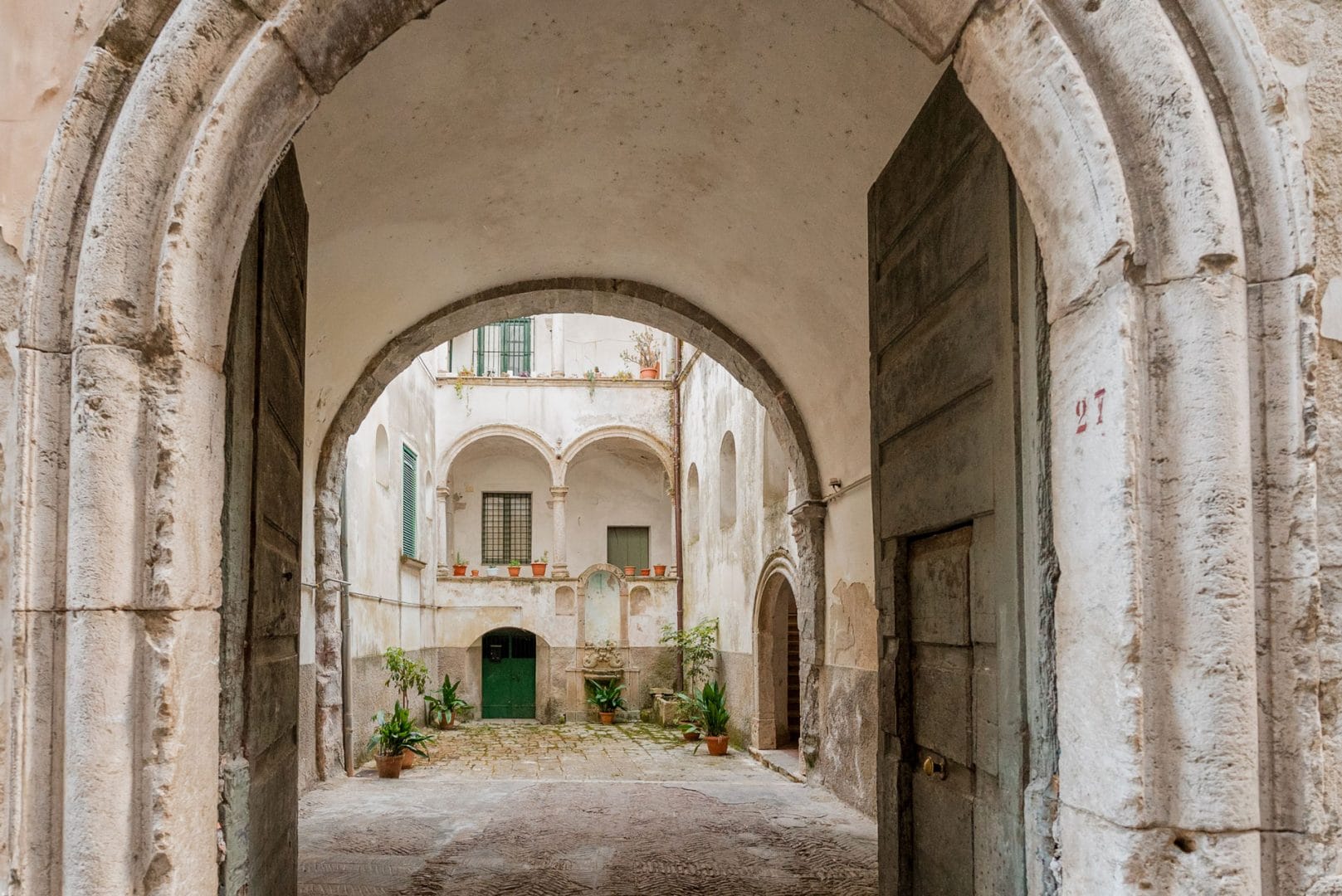

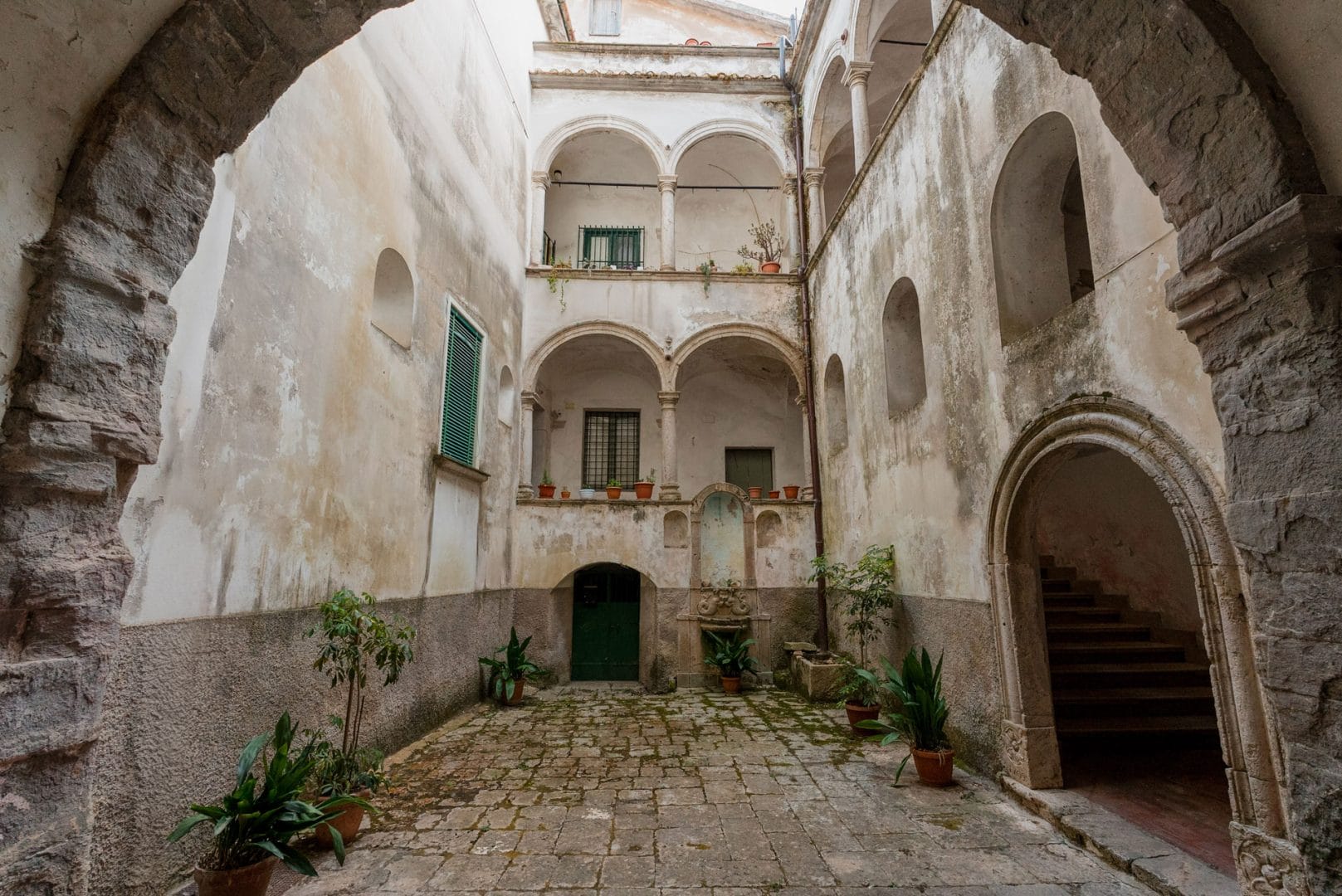
In heart of the historic centre of Campagna, the imposing portal of Bernalla Palace, one of the most elegant mansions in the ancient city. The arched entrance, carved in local limestone, leads into an inner courtyard that still retains the grace of the Southern Renaissance. Built in the 16th century at the behest of the Bernalla family, one of the most influential noble families in the city, the palace bears witness to the economic and cultural prosperity that Campagna experienced between the 16th and 17th centuries, period when the town was enriched with new palaces, churches and convents. The complex, articulated around a quadrangular porticoed courtyard, represents a perfect example of transitional residential architecture between Renaissance and Baroquesober on the outside, refined on the inside, with harmonious proportions and well-balanced details. The upper loggia, supported by stone columns and decorated with simple but elegant capitals, creates an effect of lightness that contrasts with the solidity of the rusticated ashlar base. The original layout was on two floors, with reception rooms on the piano nobile and service and storage spaces on the ground floor, as was typical of noble residences of the time. Despite the changes it has undergone over the centuries, the palace retains the charm of its era and the family character of a lived-in house, in which the courtyard, loggia and staircase of honour still interact in perfect continuity. Today Palazzo Bernalla is recognised as one of the most representative pieces of civil architecture in the urban fabric of CampagnaIts inner courtyard, bright and cosy, is a window on the daily life of a city that has been able to combine the nobility of art with the simplicity of living.
La Bernalla family, of ancient Campagnese origin, belonged to the local nobility since the late Middle Ages. Its members held administrative and religious offices, contributing to the civic life of the city. The palace was probably built in the first half of the 16th century, at a time of fervent urban renewal that saw the great families compete in the construction of prestigious residences. Their coat of arms, once visible on the entrance portal, testified to the family's role within the city's patriciate, linked to the nascent diocese and the main religious institutions. Over the centuries, as was the case for many palaces in the old town, also Palazzo Bernalla changed owners and functionsfrom a stately residence to a bourgeois dwelling, then partly to a private house and agricultural warehouse. However, the architectural structure remained largely intact, demonstrating the solidity of its construction and the respect with which its successive inhabitants preserved its memory. Today, through its walls and arches, the palace tells not only the story of a family, but that of an entire community that, over time, has continued to inhabit beauty.
The courtyard of Palazzo Bernalla, with its round arches and elegant stone columns, represents one of the best examples of 16th-century residential architecture in the Campagnese area. The entrance portal, in chiselled stone, introduces an intimate and proportioned courtyard, where every element responds to a design of balance and symmetry: the main arch, the side staircase, the openings facing the upper loggia. This language, derived from Neapolitan and Amalfi models, finds a more sober and functional declination in the palace, suited to the climate and daily life of the hill town. The surfaces, although bare, reflect a elegant taste that favours geometric clarity and controlled use of decoration. The light plaster and exposed stone dialogue with the light of the courtyard, restoring a sense of calm and continuity. The loggia on the piano nobile, with its slender columns and stone balustrades, was a place of representation and meeting; from there, on feast days, the owners would appear during processions through the city. Today, the palace retains its function of architectural memorya precious fragment of Campagna's urban history, witness to the continuity between private and collective space, between the nobility and the people.