
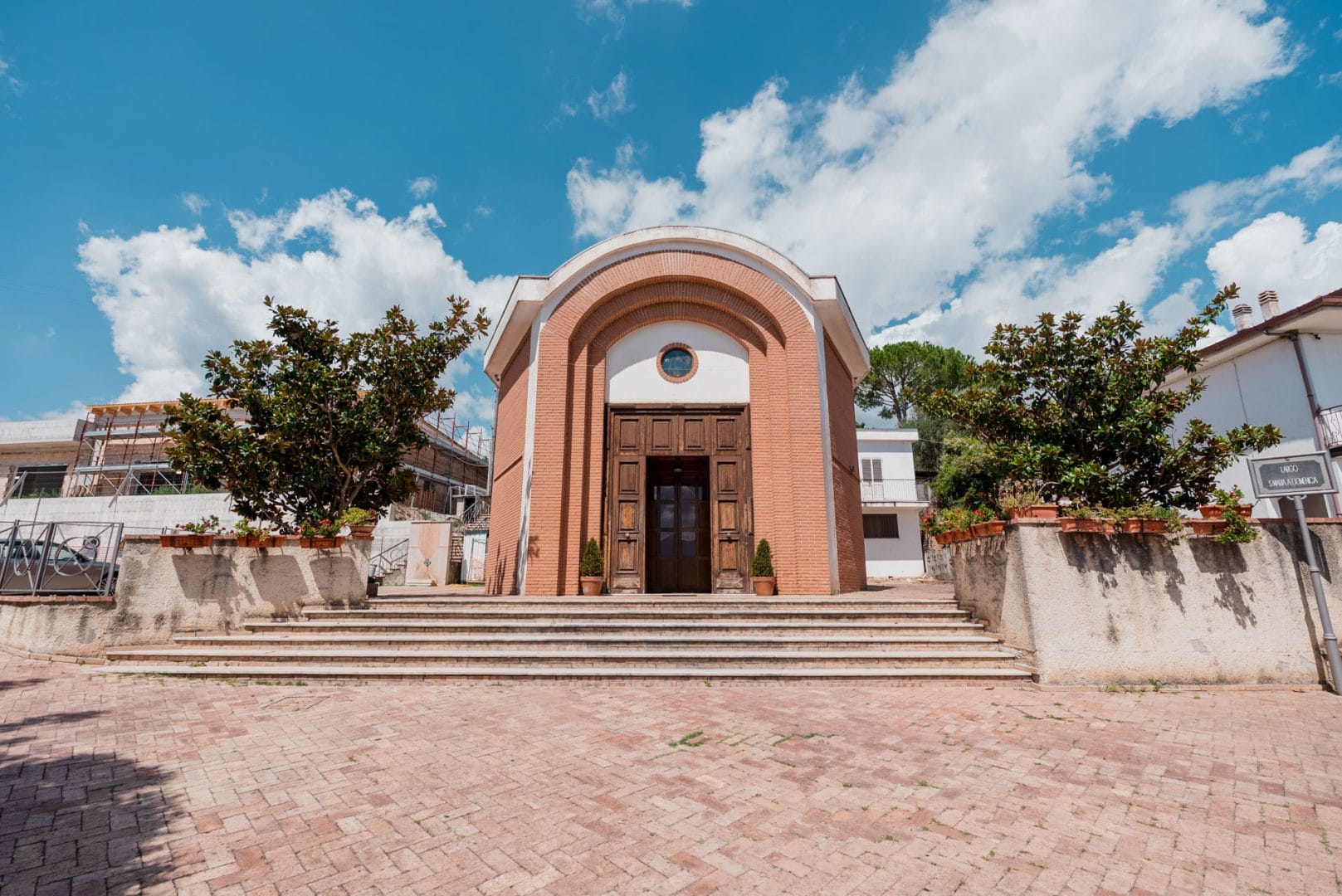
La church of Santa Maria Domenica is located in the hamlet of Camaldoli, along State Road 91 of the Sele Valley, in a hilly area framed by olive groves and overlooking the courses of the Sele and Trigento rivers. It is the religious heart of a small community that, since the second half of the 20th century, has seen the growth of housing, agricultural activities and services related to the valley floor road system.
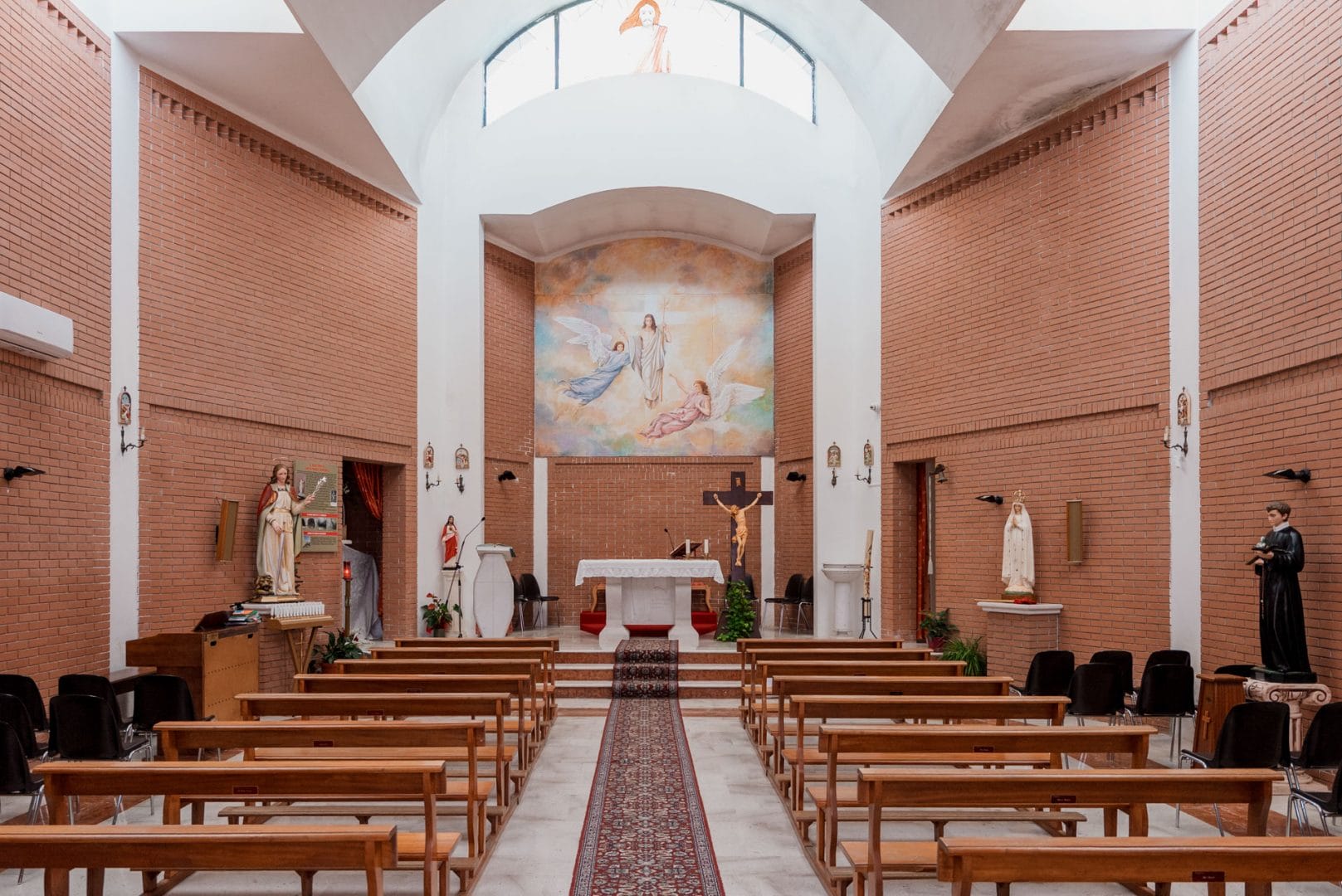
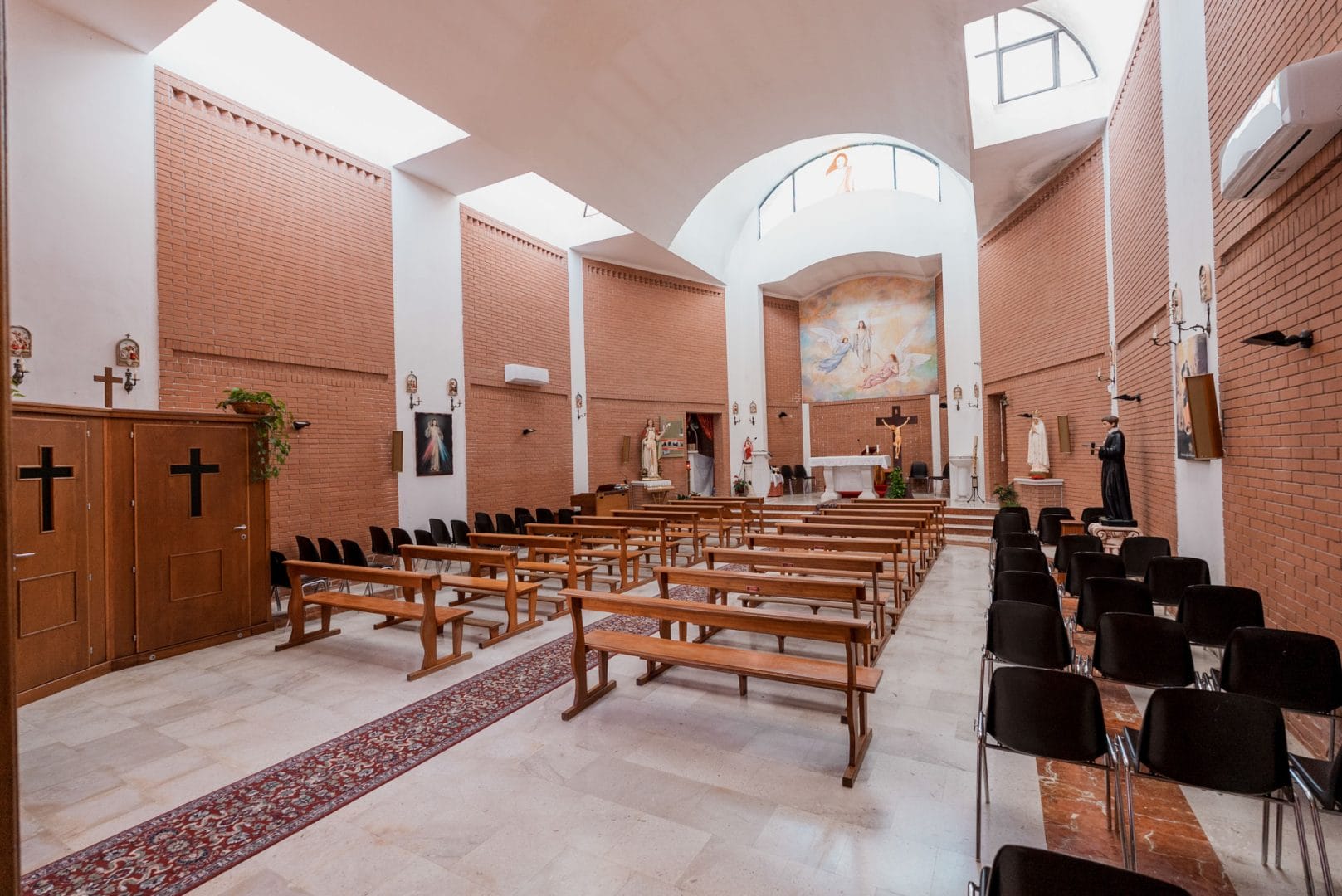
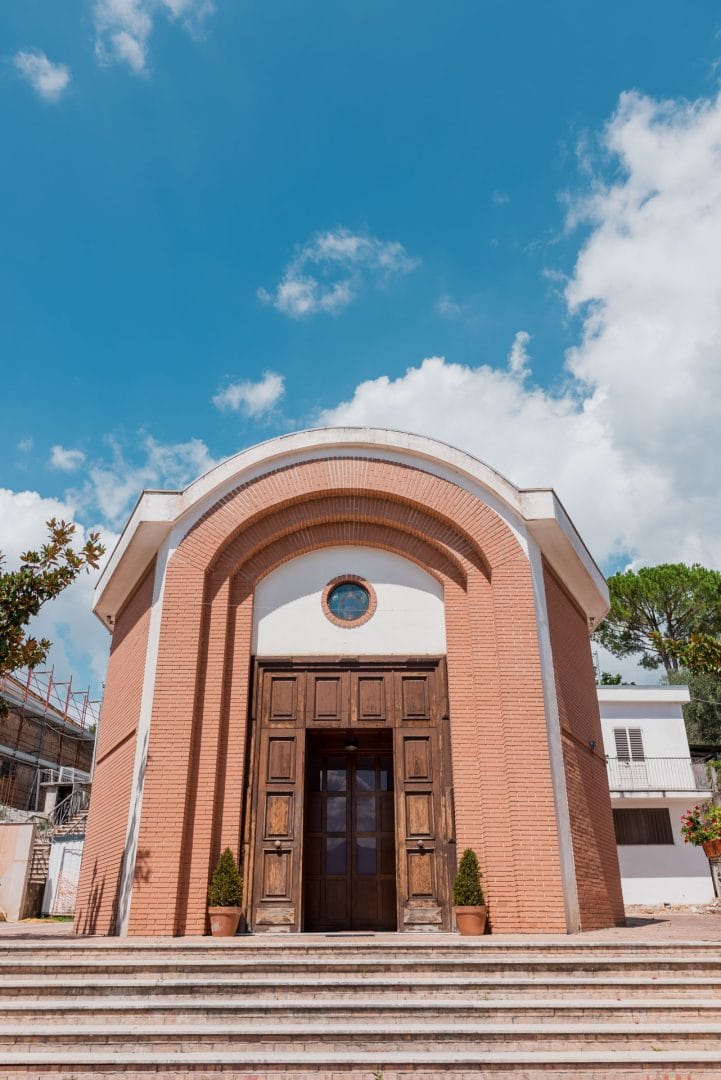
The current building stands on the same site as the previous church, built in the 1950s and demolished after the Irpinia earthquake of 1980 due to the severe damage suffered. The new church, built with contemporary architectural lines, presents a single-nave hall with a single altar, designed to gather the community in a simple but dignified manner, in visual dialogue with the surrounding landscape.
In 1990 the title of St Mary Sunday is raised to parish-sanctuary, in recognition of the ancient cult of the Campagnese martyr, linked to the tradition that places her birth and martyrdom in this very countryside. From 2014 the parish is entrusted to the community of Serradarce, within the Campagna-Colliano deanery of the Salerno-Campagna-Acerno diocese, while maintaining strong identity roots in the hamlet of Camaldoli.
The church today is a reference point not only for ordinary liturgical life, but also for the celebrations in honour of St Mary Sunday, which draw the faithful from Campagna and other centres in southern Italy united by the same cult. Pilgrimages, moments of prayer and cultural initiatives contribute to making this sanctuary a place where local history, popular devotion and contemporary spirituality are inseparably intertwined.
The sanctuary of Camaldoli is dedicated to Saint Mary Sunday, a Christian martyr who lived according to tradition between the 3rd and 4th centuries. Local sources report that Maria Domenica was born in what is now San Abbondio, in the Campagna area, around the year 285, to Dorotheus and Arsenia, in a context marked by the progressive spread of Christianity and the persecutions ordered by the Emperor Diocletian.
Educated in the new faith, Maria Domenica would face threats and pressure to remain faithful to the Gospel. According to hagiographic tradition, the young girl suffered the martyrdom by decapitation in the vicinity of the site now occupied by the sanctuary, around the year 303. Her relics would later be transferred to Tropea, where the saint is venerated as patron saint and where her cult has been widespread over the centuries.
Local historians such as Nicolò De Nigris e Antonino Vincenzo Rivelli, In their works dedicated to Campagna, they recall this tradition, linking the figure of St. Maria Domenica to the events of the territory in late antiquity. In more recent times, initiatives promoted by the city of Campagna and the diocese have strengthened the link between the various centres in southern Italy that guard the memory of the martyr, through pilgrimages, cultural meetings and the symbolic “votive lamp” that travels between communities united by the same cult.
For the city of Campagna, St. Maria Domenica is today a minor co-patron saint alongside other figures of reference: her name recurs in liturgies, catechetical itineraries and pastoral initiatives aimed above all at young people, to whom she is proposed as an example of consistency, courage and fidelity in trial.
La history of the church of Santa Maria Domenica cannot be separated from that of the hamlet of Camaldoli and the nearby Camaldolese hermitage. The locality, once known as San Abbondio, in fact takes its name from the cenoby founded in the 16th century by Camaldolese monks from Naples, dedicated precisely to Santa Maria Domenica. The complex, comprising a chapel, relief, guest quarters, threshing floor for threshing grain and oil mills, bears witness to a ancient interweaving of hermit life, agriculture and spirituality.
In Twentieth century, next to the hermitage and along the new road SS 91, a parish church was built in the 1950s to accommodate the growing population of the hamlet. However, the 1980 earthquake marked a dramatic caesura: many civil buildings were destroyed and the church itself was rendered unfit for use, until the decision was made to demolish it. Camaldoli thus finds itself called upon to rethink its symbolic and gathering places.
The construction of the new church, on the same site as the previous one, represents the concrete response of a community that chooses to rebuild not only walls, but relationships and memory. The contemporary architectural lines, the single nave hall and the sobriety of the interior spaces reflect the desire for a simple, functional and open building, capable of hosting both liturgical celebrations and moments of meeting and listening.
In the meantime, the ancient Camaldolese hermitage, now privately owned, continues to fascinate with its isolated position and the still legible traces of a centuries-old history. The ideal dialogue between hermitage and sanctuary, between monastic memory and contemporary parish life, makes Camaldoli a place where devotion to Santa Maria Domenica is expressed in different forms, but always profoundly linked to the territory, its landscapes and its communities.