
The building today known as De Vargas Machuca Palace, also referred to in local sources as Cervone Palace, is one of the most representative stately buildings of the historic centre of Campagna. The official records of the City of Campagna ETS and the RegOOn portal date it to 17th century and place it on Largo della Memoria, in the upper part of the city, in a position slightly off the main axis but well within the historic urban fabric.
The same sources point out that the palace is named after the Cervone family, an ancient local dynasty that played an important role in the civil and religious life of the town. In later times, through hereditary succession, the building passed to the De Vargas Machuca, principles of Migliano, branch of a great noble family of Spanish origin rooted in several centres of southern Italy. It is from this phase that derives the use, in some descriptions, of referring to the palace as “De Vargas Machuca Palace”, although the traditional name of Cervone Palace.
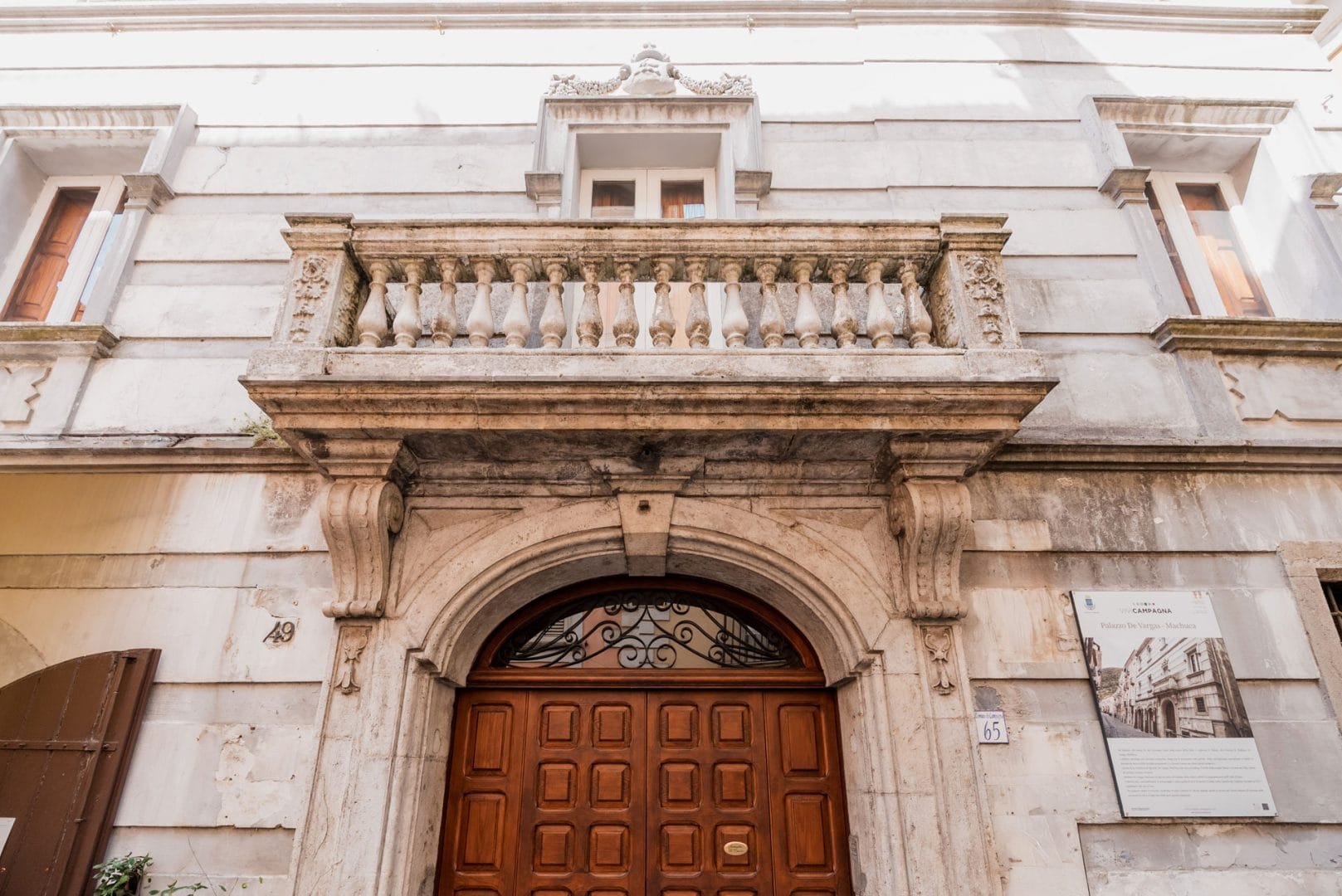
From an architectural point of view, the palace stands out for the quality of the entrance portal, the richness of the vaulted atrium and the presence, in the inner courtyard, of a neoclassical fountain and a fishpond. Elements that, taken together, tell of the level of representation that the stately home retained between the 17th and 18th centuries and today make it a compulsory stop on itineraries to discover the historical palaces of Campagna.
Descriptions mention that the palace was originally named after the family Cervone, powerful and long-lived in the town's history. Their coat of arms stood out on the vault of the entrance portal and, although only partially legible today, it continues to testify to the ancient link between the family and the building overlooking Largo della Memoria.
Later, «by way of succession», the palace passed to the De Vargas Machuca, princes of Migliano, an aristocratic lineage attested in the Kingdom of Naples with numerous titles and properties spread across Cilento, the Neapolitan area and other southern territories. For Campagna, this acquisition meant the building's entry into the network of residences linked to the princely family.
Although we do not currently have a detailed chronology of the changes of ownership, the concordant indications available make it possible to reliably link the palace to the history of the lineage. It is precisely from this connection that the name by which, in some popular contexts, the building is today remembered as De Vargas Machuca Palace.
More detailed descriptions of the building insist on some architectural elements of special significance. On the outside, the building is characterised by the «.«beautiful rusticated portal»round arch, which opens onto the Largo della Memoria. The portal is surmounted by a marble coat of arms, once fully legible, recalling the Cervone family coat of arms and emphasising the representative character of the entrance.
Through the portal you enter a covered atrium by a vault decorated with a fresco, indicated as one of the most valuable elements of the palace. From here, the view opens up towards the inner courtyard, where a neoclassical fountain and a fishpond form the scenic centrepiece of the space: according to local tradition, the fishpond was formerly used as a tank for breeding fish for the families residing in the palace.
Overall, the combination of rusticated portal, frescoed vaulted atrium and courtyard with fountain and fishpond offers a clear picture of the level of care reserved, between the 17th and 19th centuries, for the residences of the most influential families in Campagna. Although it cannot be visited continuously, De Vargas Machuca/Palazzo Cervone remains a prominent feature in the urban landscape of the historic centre and a significant testimony to the city heritage.