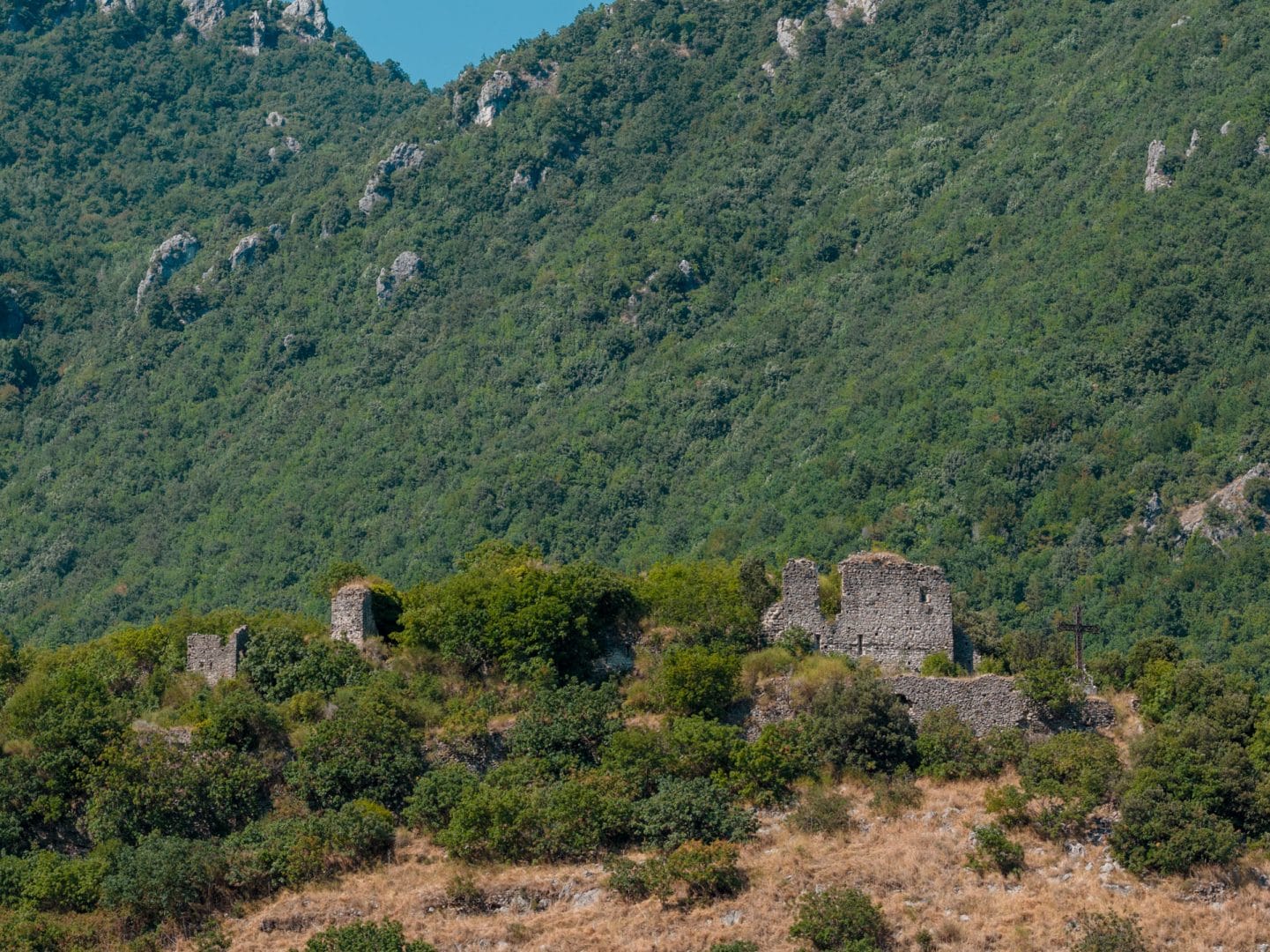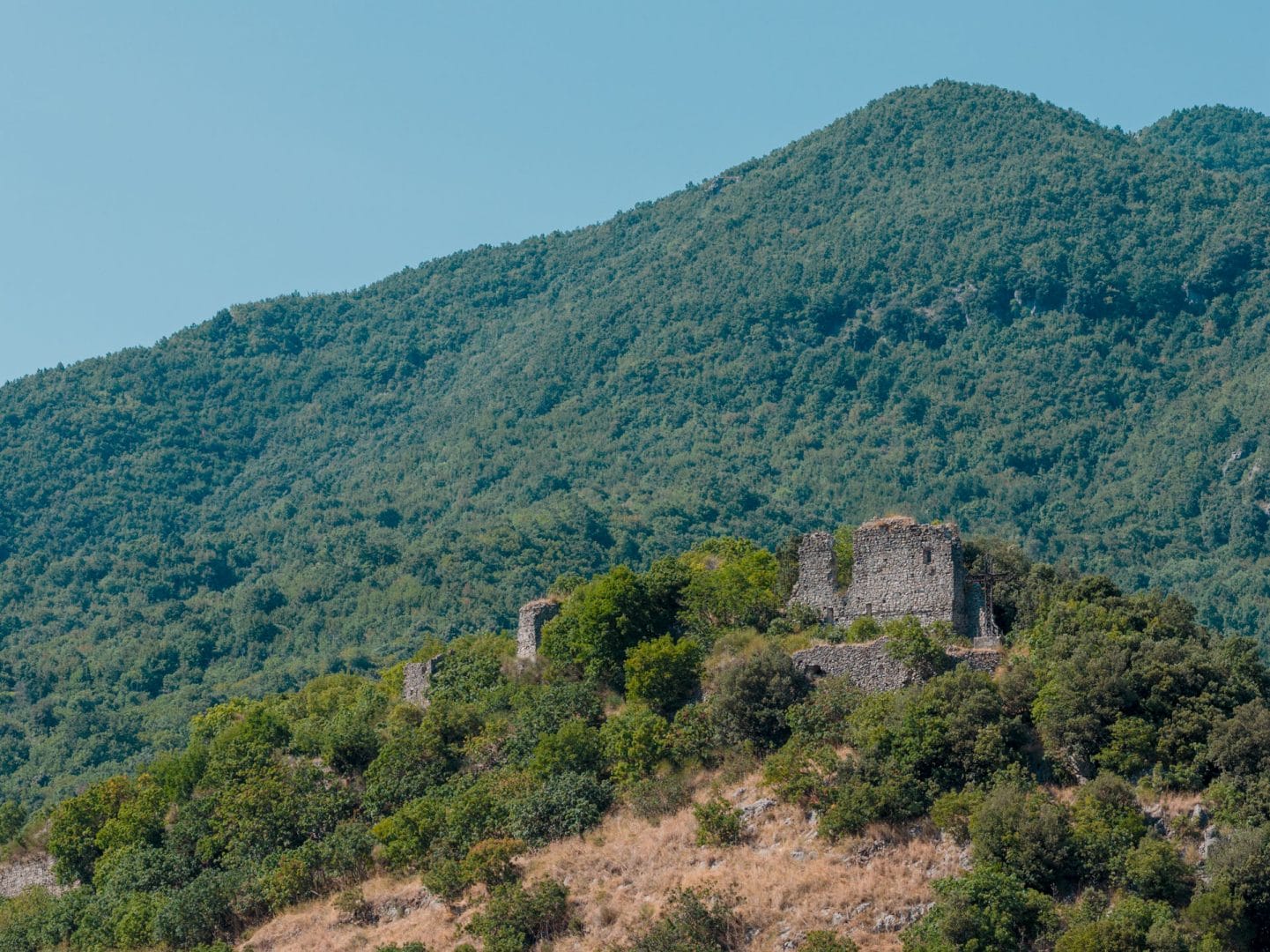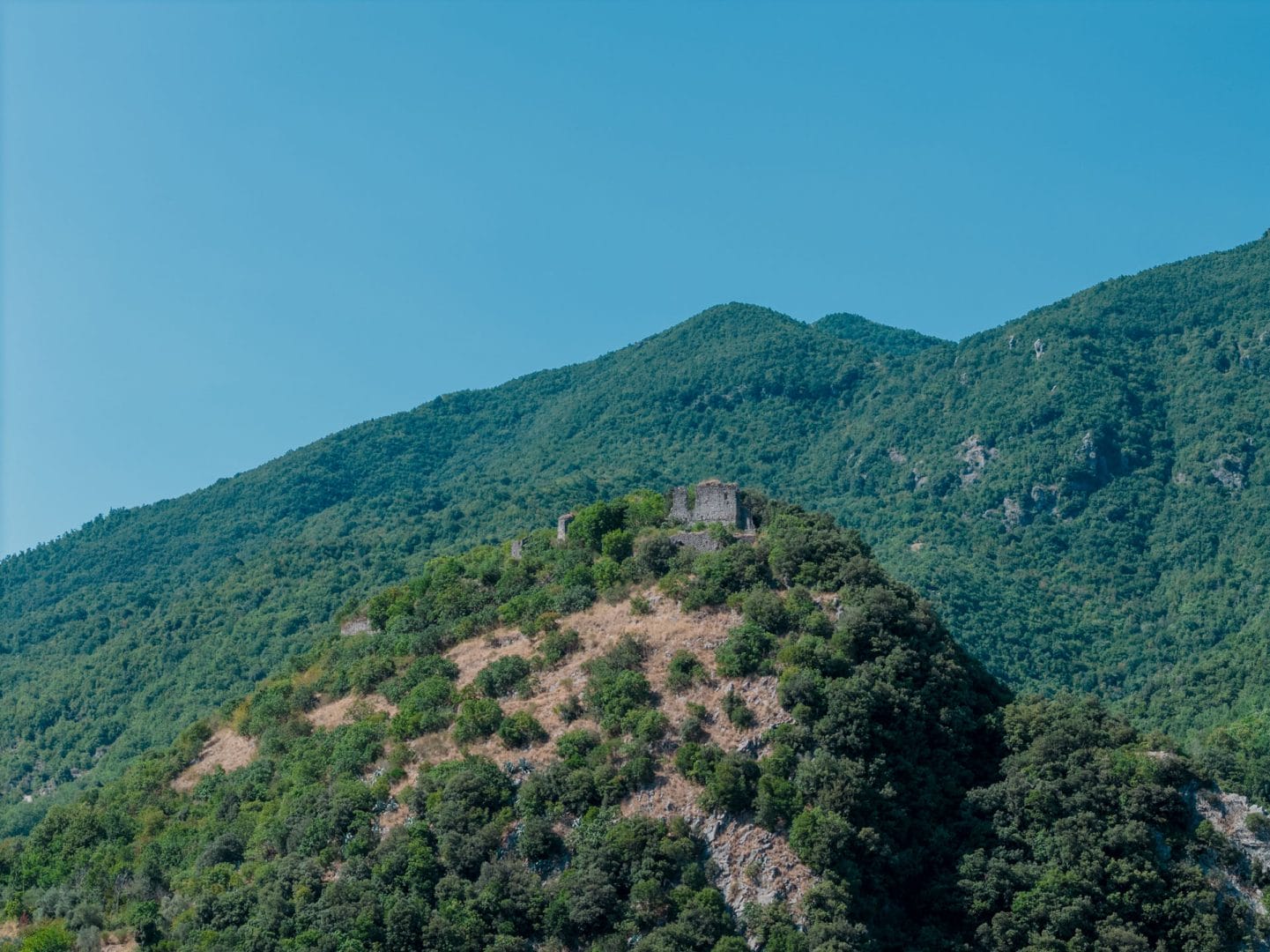

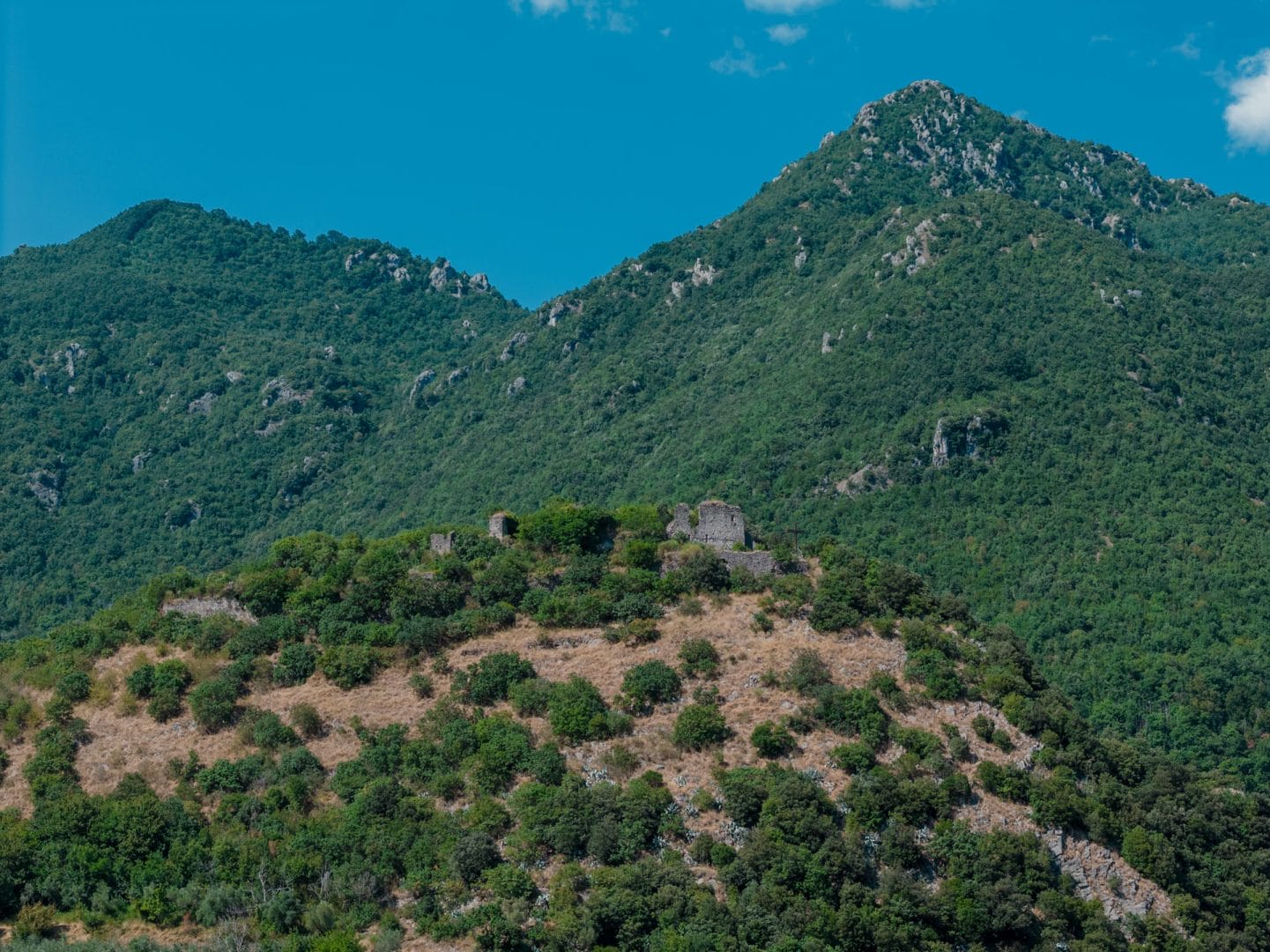
On the slopes of the Monte Girolo, At an altitude of about 440 metres, the remains of the Gerione Castle, ancient medieval fortress that for centuries was a symbol of Campagna's political and military power.
Its position, naturally defensive and strategic, allowed it to control the Sele valley and the main roads connecting the plains and the Picentini Mountains.
First mentioned in 1056, the castle represented the original nucleus around which the first urban settlement of the city developed. Its history reflects the vicissitudes of medieval Campania: first under the dominion Norman, then Swabian and Angevin, finally Aragonese.
The place name “Gerione” (or “Girone”) appears in documents from the Norman period and may derive from the name of the hill on which it stands, “Girolo”, or the legendary Geryon, mythological figure associated with the number three and perhaps the triple wall that characterised the fortification.
The original structure, elongated and connected to the mountain profile, was built of local stone with towers, curtains and internal walkways. Throughout the Middle Ages, the castle performed functions of control and defence of the territory, becoming the seat of the garrison, administration and refuge for the population during raids.
Today there remain stretches of walls, plinths and a rock-cut cistern, but the grandeur of the ruins and the panoramic location retain the sense of strength and solitude that characterises the ancient medieval fortifications.
The Gerione Castle was among the royal fortresses mentioned in the registers of the’Assizes of Capua (1220), with which the Emperor Frederick II of Swabia confirmed that it belonged to the imperial domain.
It was therefore a castrum exemptum, a fortification directly subject to the power of the Emperor and not to the local feudal lords.
The structure presented mighty walls, quadrangular towers and a main entrance with drawbridge; Inside were soldiers' quarters, storerooms and a chapel dedicated to Saint Leonard, a saint particularly venerated in military garrisons.
During the 14th and 15th centuries, the castle was extended and kept efficient by the families that ruled Campagna: first the Orsini del Balzo, then the Grimaldi, which in 1532 obtained the title of Marchesi di Campagna.
The site played a strategic role in the defence system of the Sele Valley, visually connected with the towers of Eboli e Contursi.
Records show that inside there were weapons depots, grain stores and safe environments where the rural population found refuge in times of danger. The castle thus became a symbol of authority and protection, point of reference for the entire territory.
With the advent of new techniques of warfare and the introduction of firearms, the defensive function of Castle Giron began to decline.
In 1555, under Spanish rule, it was decreed the dismantling, so that it could not be used in any uprisings against the Crown.
In later centuries, the surviving structures were reused as prison e deposit, until it was gradually abandoned in the 17th century. Vegetation and erosion slowly erased its silhouette, but not its memory.
Today, the site preserves significant remains of the perimeter walls, of some towers and of subterranean environments.
The area can be reached via a panoramic trail which joins the rural roads north of the city and is one of the area's most attractive nature destinations.
From the top of the Girolo you can enjoy a spectacular view over the Sele Valley and the Picentini Mountains, while the silence of the place restores the archaic atmosphere of a medieval countryside.
The castle ruins, although not restored, are the subject of studies and survey campaigns promoted by local authorities and cultural associations, with the aim of enhancing the site as a historical and landscape heritage.
The Gerione Castle remains a living presence in the landscape, a symbol of resistance and identity, where stone and memory dialogue with the wind and time.