

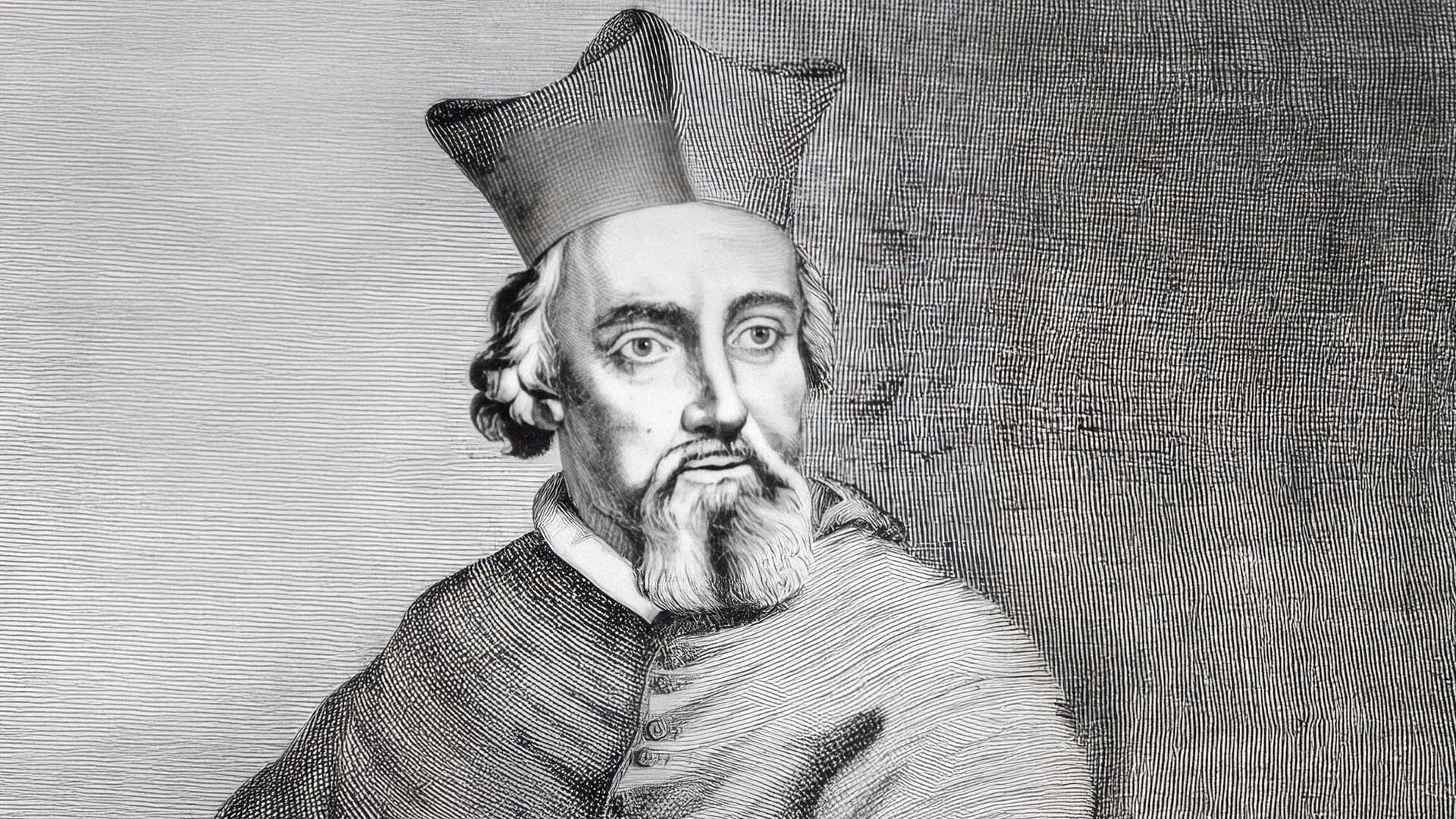
Juan Caramuel y Lobkowitz was born in Madrid on 23 May 1606 by Lorenzo Caramuel, a nobleman of Flemish origin, and Catherine Frisse, from a Bohemian family. He entered the’Cistercian Order, he trained between Spain, Portugal and the Netherlands, immediately distinguishing himself as an encyclopaedic mind: theologian, mathematician, astronomer, linguist, author of dozens of works ranging from philosophy to logic, from architecture to music. After holding important positions in the Church - including vicar general in Prague and consultant to the Holy Office in Rome - he was appointed, on 9 July 1657, bishop of the diocese of Campagna and Satriano, in the Kingdom of Naples.
When he arrived in Campagna, in 1657, he found a diocese severely scarred by the plague of 1656, with the clergy and population drastically reduced. In this complex context Caramuel combined pastoral leadership with intense intellectual activity, He turned the small town in Campania into one of the most lively centres of his biographical itinerary: here he continued to study, write and design, leaving a lasting imprint on the local memory.
For over fifteen years, 1657 to 1673, Juan Caramuel held the United Diocese of Campagna and Satriano. Local sources recall how he inherited a Church poor in means, but not in pastoral needs: priests reduced to a few, faithful tried by epidemics, mountainous territories difficult to reach. Caramuel faced this situation with firmness e reforming spirit, visiting parishes, taking care of clergy training and engaging in preaching. He loved solitude and spent periods of retreat in the’Hermitage of San Michele on Monte Nero, where he found the silence necessary for study and prayer.
A man of great social sensitivity, he was close to the poor and the sick, but at the same time strict in the exercise of his ecclesiastical authority. He personally taught grammar to the children of Campagna, elaborating innovative teaching methods and simplified texts to encourage learning. To support his intense book production, he organised a printing house - the ’Arca Santa“ - operating between Sant'Angelo Le Fratte and Campagna, where some of his best-known works were printed, such as the ”Mathesis biceps"and treatises on metrics and theology.
One of the protagonists of European culture in the 17th centuryo. Caramuel He maintained relations with scholars and thinkers such as René Descartes, Pierre Gassendi and Athanasius Kircher, participating from afar in the great philosophical and scientific debates of his time. Historiographical tradition records him among the forerunners of the binary numbering system and how author of bold logical and mathematical reflections, also capable of influencing the subsequent history of scientific thought.
In 1673 was transferred to the diocese of Vigevano, in Lombardy, where he designed the new façade of the cathedral and the scenic square in front of it, now considered one of the masterpieces of Baroque town planning. He died on’8 September 1682 in Vigevano, after a life marked by travel, studies and pastoral responsibilities. For Campagna remains "the unforgettable bishop"which, despite difficulties and contrasts, brought the breath of Baroque Europe to a small diocese in the south of Italy, leaving a’heritage of faith, culture and research which today is gradually being rediscovered and enhanced.